


Come join our exploration session of the SPRINGS model chain. We want to know whether it reflects how knowledge is actually produced, connected and passed on between disciplines.
🗓️ Date and time
Monday 14 December 2026 · 13:00-16:00 CET · 3 hours · Online (Microsoft Teams)
ℹ️ About the session
SPRINGS has built a model chain showing how information moves from global climate models and downscaling, through hydrological and water-quality modelling, to health-impact modelling, decision support and the people who make decisions.
We’ve used the chain to help researchers from different fields understand each other’s work. Now we want to test the chain itself.
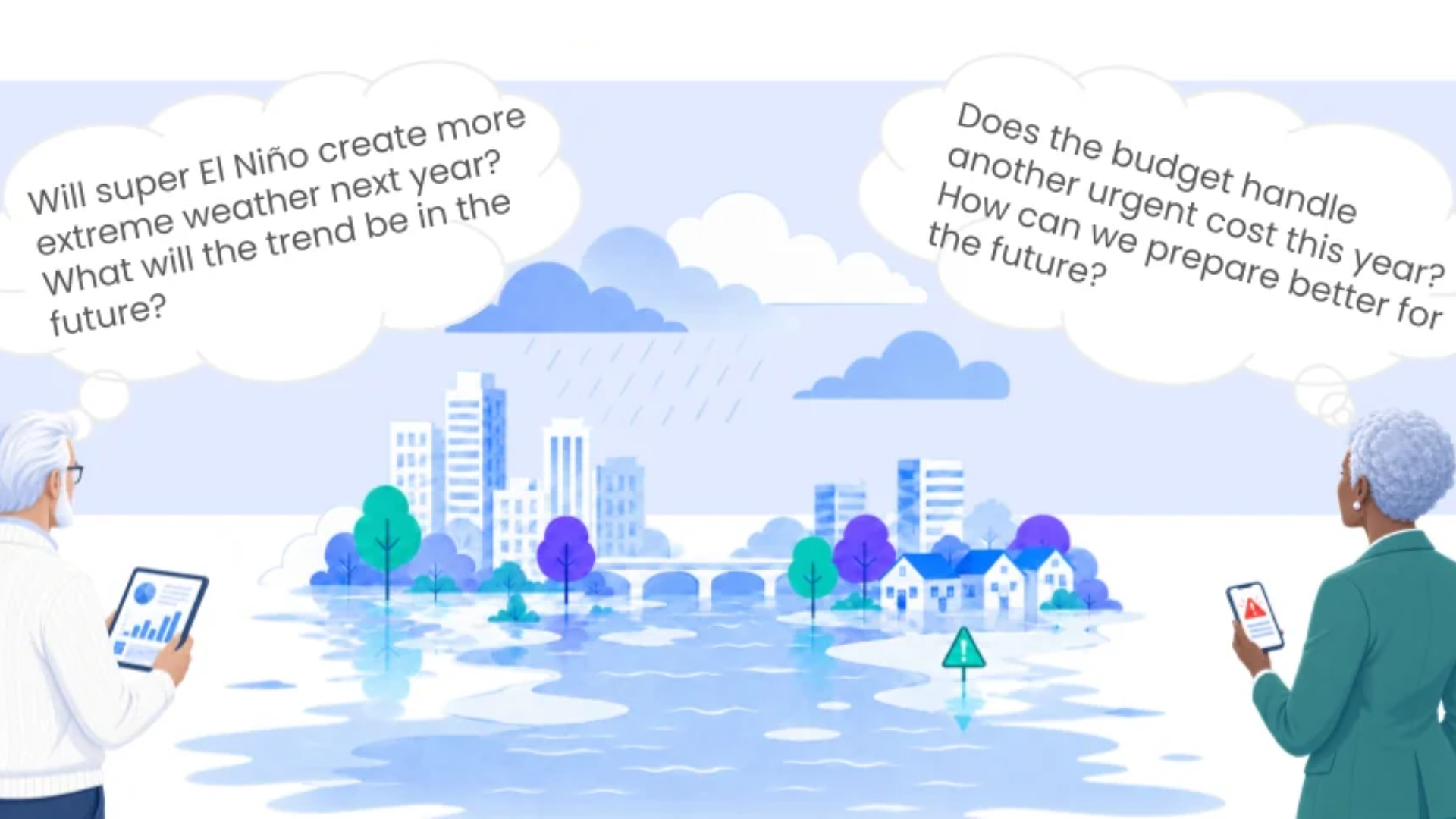
Working with it has raised questions we can’t answer alone. Is a linear chain the right way to show these relationships? What happens in the spaces between the models? Where do social, behavioural and economic factors fit? How do trust and terminology affect what gets passed on? And does the chain still hold when a decision is needed this week rather than for 2050?
We’re asking the people who produce and use this information to tell us what works, what’s missing and what needs to change.
🤝 Who should join
We’re looking for people with expertise in any part of the chain:
We’d also like to hear from people who work across these boundaries, for example in economics, behavioural and social sciences, risk and decision analysis, and science communication.
📊 What happens with your input
Your feedback will shape Version 1.0 of the SPRINGS model chain, which we’ll then test with a wider group of information users and decision-makers. It will also help us see which parts of the framework could carry over to other climate-health risks, such as air quality or wildfire smoke.
📩 Practical information
The session is held in English. You’ll receive the joining link by email once you’ve registered.
🌍 About SPRINGS
SPRINGS is a Horizon Europe project studying how climate change affects waterborne diarrhoeal diseases. It brings together 15 partners across Europe and sub-Saharan Africa, with case studies in Naples (Italy), Timișoara (Romania), Akuse (Ghana) and Haydom (Tanzania).